
The Short Version
Your company writes down what it decided and almost never why. That is not carelessness. Of the six places an organization can store memory, only one can hold a reason, and it is the one that resigns. Everyone knows Bob knows, so nobody writes it down. On the day of the decision the reason feels too obvious to record, and a year later the outcome feels too inevitable to question. Nothing replays the meeting before the memory fades. Five holes, all structural, all known for decades.
The fix has been known just as long: record the reason at the moment of decision and link it to what it replaced. Nobody did it because the only thing that could hold a reason was a person, and a person's time was too expensive to spend writing down what they already knew. That cost just went to zero. Agents can capture the why while your people make the calls, and Korium is where the company keeps it. The rest of this article is how we got here, and what it looks like when it works.
The Question I Was Not Asking
I asked Korium about a client's services. The answer came back with the name of the company they had bought two years ago, and the reason we had stopped talking about the old product line. I had not asked about any of that. Memory did what memory does: it brought back the neighbors.
That should have felt like a win. It did, for about a day.
A company's knowledge comes in three layers.
Layer 1: is what is true right now. The contract, the process, the price list.
Layer 2: is what changed and when. The version history, the audit log, the dates.
Layer 3: is why it changed and what else was on the table.
Here's what a year of building Korium taught me:
Layer 1 is easy to track. Most companies do this, or they don't make money.
Layer 2 gets lost in the shuffle. Sometimes it's written down, sometimes not. Sometimes it lives with the one person who knows everything about everything, and sometimes that person leaves.
Layer 3, forget it. If we spent our time tracking every little nuance, we probably wouldn't run a business. But that's not a reason not to do it. It's a reason to figure out how to do it effortlessly.
So today we build agents and workflows, and they hold memory. But the memory is confined to the things we work on with them. It is confined to the models and services we use, and it is not easily shared across the enterprise. Not only that, but handing everything about the enterprise to Claude or OpenAI is a major no-no. We need another way.
And the question in the title stopped being a question about software. Why do we not invest our time in remembering decisions? We have known for fifty years how memory works. We have known for thirty how organizations lose it. Nobody built the fix for the humans. This article is about why.
tldr;: it is not a discipline problem. It is an architecture problem, and every part of the architecture is working exactly as designed.
Where a Company Keeps Its Why
Start with the obvious objection. Companies do remember. They have contracts, process documents, tickets, decks, the CRM, the ERP, and a shared drive nobody has cleaned since 2019. If anything, they remember too much.
They do. They remember the what.
In 1991, James Walsh and Gerardo Ungson published the paper that organizational memory research still stands on. They asked a simple question: when a company remembers something, where is it stored? Their answer was six places.
- Individuals. The people.
- Culture. The shared stories and language.
- Transformations. The routines and procedures that turn inputs into outputs.
- Structures. The roles and reporting lines.
- Ecology. The physical workplace itself.
- External archives. The records kept by customers, regulators, former employees and the press.
Run one decision through those six.
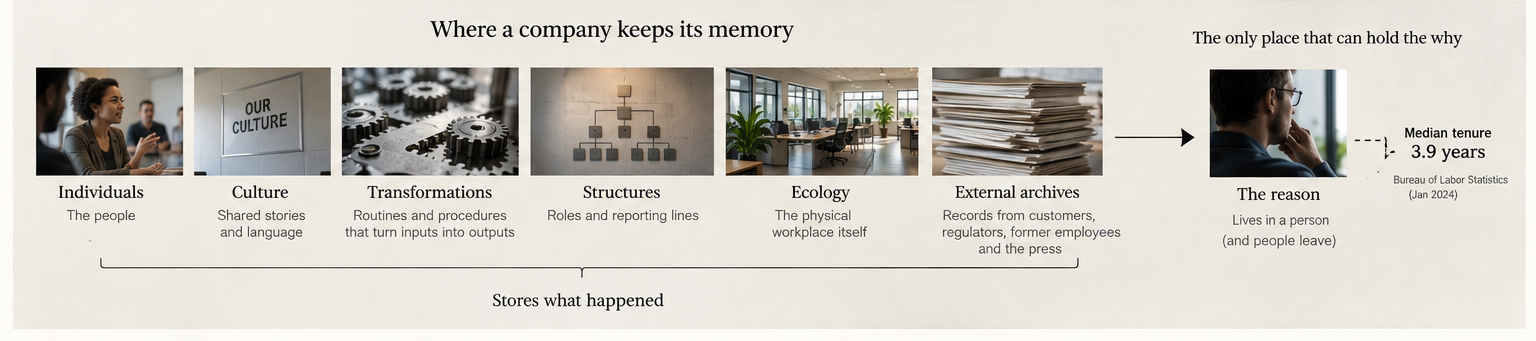
Of the six places an organization can store memory, only one is capable of holding a reason. It is also the only one with a resignation letter.
CONCEPT 1: Companies do not fail to record the why because they are careless. They fail because five of their six memory systems are physically incapable of holding it, and the sixth has a median tenure of 3.9 years (Bureau of Labor Statistics, January 2024). The company architecture stores Outcomes. Reasons and their provenance were never in scope.
Ask Bob
Companies don't remember facts, they remember who knows the facts. Bob knows the facts. What happens when Bob is no longer here?
Daniel Wegner named this in the mid-1980s. He was studying couples, and he noticed something odd: two people in a long relationship could recall more from a shared list than two strangers, even though neither partner individually remembered more. The pair had divided the work. One knew the birthdays. One knew where the passports were. Each knew what the other held.
CONCEPT 2: Wegner called it transactive memory: a system in which the group's memory is larger than any member's, because the members store the index to each other.
Every company runs on this. Nobody writes down why the Midwest accounts get net-45 terms, because everyone knows Bob knows. Nobody records why the approval step was added in 2023, because Priya was in the room. The index is rich, fast and free. It is also the reason the why never gets written down: writing it feels redundant while Bob is there to ask.
The research on what happens next is not subtle. Argote and Ren, reviewing three decades of studies, put it in one line: transactive memory systems are "negatively affected by turnover," while routines are "less dependent on the skills and expertise of particular members" (Argote & Ren, 2012).
CONCEPT 3: Translation: the routine survives Bob leaving. The reason for the routine does not.
And Bob leaves. When Panopto and YouGov surveyed a thousand US workers, 42 percent of the knowledge needed to do a job turned out to be unique to the person doing it, and the people left behind spent 5.3 hours a week waiting for knowledge someone else had (Panopto, 2018).
THE REALITY: A transactive memory system is not a failure of documentation. It is a feature. It is how a group of humans gets more capacity than the sum of its members, and it works beautifully right up to the day it doesn't. The system does not degrade. It fails on a Friday afternoon, all at once, with a high-five and a cake in the break room.
The Why Feels Too Obvious to Write
So far the answer is structural: nowhere to put the reason, and a living index that makes writing it feel pointless. There is also something going on inside the people, and it is uglier.
In 1975, Baruch Fischhoff ran a set of experiments that became the founding work on hindsight bias. He gave people historical scenarios with several possible outcomes, then told some of them which outcome had actually occurred. Those people rated the real outcome as far more predictable than the people who did not know it. Once you know how the story ends, you cannot un-know it, and the ending starts to feel like it was always coming. Fischhoff called it creeping determinism. The rest of us call it "I knew it all along."
This does two things to a decision, at opposite ends of its life.
On the day you make it, the reasoning feels self-evident. You have spent three weeks on the vendor question. The answer is now obvious to you, and obvious things do not get written down. Who documents that water is wet? So the deck records the choice, and the three weeks of forces that produced it evaporate by the time the meeting ends.
Fourteen months later, the outcome has arrived. Maybe the vendor was fine. Maybe the account lost four points of margin. Either way, hindsight makes the result look inevitable, and inevitable results do not invite questions. Nobody asks why, because why now seems like a strange question to ask about something that was obviously going to happen.
Hindsight bias erases the record at both ends. It stops the reason from being written, and then it stops anyone from missing it. Shane Parrish, who has spent years arguing for decision journals, puts the mechanism plainly: "Hindsight makes things far more explainable and changes our story" (Farnam Street). The journal exists to record "what you knew and what you thought at the time," before your own brain rewrites it.
Almost no one keeps one. Not because they are lazy. Because at the moment it would help, it feels unnecessary, and by the moment it is necessary, it feels irrelevant. The bias is doing its job.
There Is No Sleep in an Org Chart
The brain has a fast memory and a slow one, and it moves things between them by replaying the day during sleep and in the pauses while you're awake (McClelland et al., 1995; Buzsáki, 2015). Consolidation is not a filing step at the end of the day, it is a habit the brain runs in the gaps.
Now look at a company through that lens.
The meeting is the fast memory. For fifty minutes, everything Layer 3 needs is in the room: the three options, the one nobody liked, the constraint from legal. Then the meeting ends, the notes record the action items, and nothing plays the reasoning back into anything durable. A company has plenty of fast memory and no slow memory at all.
The window for fixing that is short. Sönke Ahrens, writing about the Zettelkasten method, says fleeting notes must become permanent notes within a day or two, because after that the context that made them meaningful is gone (Ahrens, 2017).
The reasoning from Tuesday's meeting is a fleeting note.
By Thursday it is noise.
By the following quarter it is Bob.
CONCEPT 4: Organizations lose the why the same way you forget a phone number heard once at a party: nothing rehearsed it before the window closed. The brain solved this with sleep. The company never built the equivalent.
Organizations Forget on Purpose Too
I want to be careful here, because there is an easy version of this argument that says all forgetting is bad. It isn't.
De Holan and Phillips spent years studying how organizations forget and found it is as real a process as learning, and just as consequential (de Holan & Phillips, 2004). Some forgetting is deliberate: dropping a routine that stopped working. Some is accidental: the knowledge erodes, or leaves in someone's head. A healthy company needs the first kind. The problem is it cannot tell the two apart, because it never wrote down what it decided to forget, or why.
Drop a process step on purpose and, with no reason recorded, it looks exactly like an oversight. Two years later someone puts it back and relives the problem it was removed for. Nygard saw the same thing in software: newcomers who don't know why a decision was made either accept it blindly or change it blindly (Nygard, 2011). Without the why, both are guesses. With it, one of them is a decision.
CONCEPT 5: It is not only that we fail to remember decisions. We also fail to remember our own forgetting. A company that forgets well, on purpose, with the reason recorded, is doing something sophisticated. A company that forgets by default is just leaking, and cannot tell the difference between the two.
Filling the Holes
Each of those five concepts is a hole in the architecture. I've thought through how to fill them, and it is why Kyroco's method has four verbs now instead of three.
Concept 1: the architecture stores outcomes, never reasons. So we add a place for reasons. Not a wiki and not a field on a form. A record that sits next to every decision the workflow makes and holds the same three things Nygard put in an ADR fifteen years ago: the forces in play, the choice, and what it replaced. The what and the why stored together, so one can never outrun the other.
Concept 2: the company remembers who knows, not what they know. So before anything else, we map the index. We follow the work end to end and ask, at every decision that shapes it: who would you call? When the same name comes back over and over, we have found the load-bearing wall. This happens before anyone says the word AI, because you cannot automate a process whose reasons are in a head you have not met.
Concept 3: the routine survives Bob, the reason does not. So the reason has to be captured while Bob is still here, and by something that isn't Bob. An agent sits inside the workflow, hears the decision, writes the why, and links it to what it replaced. Bob keeps making the calls. The machine keeps the record. When he leaves, the routine and its reasons leave the building together, which is to say it never does.
Concept 4: there is no consolidation step. So we build one, and we put it inside a moment that already exists. The two minutes at the end of the meeting where the decision, the options that lost, and the constraint that forced it get said out loud. Not a Friday ritual. A step at the point of decision, while it is still warm, before hindsight has a chance to make it look obvious. And because nobody has time to do this by hand, the agent does it. If tracking every nuance cost human hours we would not run a business. Effortless was the requirement, not the aspiration.
Concept 5: the company cannot tell deliberate forgetting from a leak. So nothing gets deleted. A decision that replaces another is linked to it, and the old one is marked as no longer current, not as wrong. Those are different things. When someone drops a step on purpose, the drop carries its reason, and two years later it reads as a decision instead of an oversight. This is what Korium holds: what was decided, by whom, when, what it superseded, and why. Kept by the company, shared across it, and not handed to a model vendor.
That last part is the fourth verb. See the work, shape it, build it, and keep what you learned, so the next time you look, you start from what Bob already knows.
Back to the Question
Why do we not invest our time in remembering decisions?
Because until now it was too expensive.
Every hole above has been known for decades. The fixes have been known too: write the reason at the point of decision, link it to what it replaced, keep the old one readable. Software engineers have done it by hand since 2011. Nobody did it for the rest of the business because the only thing that could hold a reason was a person, and a person's time is the most expensive thing a company has. Recording the why meant paying Bob to write down what Bob already knew. So nobody did, and the reasons walked out with him.
That cost just went to zero. An agent can sit in the meeting, hear the decision, write the why, and file it against what it superseded, without anyone's afternoon. The capture that used to need a discipline no company could sustain now needs nothing from the people in the room.
That is what Korium is. Not a wiki, a bunch of local md files, and not a chatbot with a longer memory. The place where a company keeps its reasons, filled by the agents that already do the work, shared across the enterprise and owned by the company, not by whoever sells the model this year.
We spent thirty years unable to afford remembering why. Now we can. The only question left is whether you start before or after Bob leaves.

Robert Sfeir is the founder and CEO of Kyroco, where he helps companies redesign how work gets done before bringing AI into it, and builds Korium, the memory layer that keeps what they learn. He has an unhealthy obsession with making things remember why. The earlier articles in this series argued that synthetic users make product research faster, that institutional memory turns them into characters with history, and that working memory is the layer everyone skipped. This one argues that the humans skipped it first.
Citation List
Organizational memory and forgetting
- Walsh, J. P. & Ungson, G. R. "Organizational Memory." Academy of Management Review, 1991. The six retention facilities: individuals, culture, transformations, structures, ecology, external archives. Overview
- Wegner, D. M. "Transactive Memory: A Contemporary Analysis of the Group Mind." 1987. Groups encode, store and retrieve knowledge by remembering who knows what; origin in studies of couples. Summary
- Argote, L. & Ren, Y. "Transactive Memory Systems: A Microfoundation of Dynamic Capabilities." Journal of Management Studies, 2012. Transactive memory systems "negatively affected by turnover"; routines less so. PDF
- de Holan, P. M. & Phillips, N. "Organizational Forgetting as Strategy." Strategic Organization, 2004, and "Remembrance of Things Past? The Dynamics of Organizational Forgetting." Management Science, 2004. Forgetting as a first-class process, accidental and deliberate. Link
- Panopto and YouGov. "Workplace Knowledge and Productivity Report." 2018. Survey of 1,001 US workers: 42 percent of job knowledge unique to the individual; 5.3 hours a week waiting for knowledge held by others. Vendor survey; treat figures as directional. Release
- US Bureau of Labor Statistics. "Median tenure with current employer was 3.9 years in January 2024." BLS
Cognitive science
- Fischhoff, B. "Hindsight ≠ Foresight: The Effect of Outcome Knowledge on Judgment Under Uncertainty." Journal of Experimental Psychology, 1975. Creeping determinism; outcome knowledge raises judged predictability. Summary
- McClelland, J. L., McNaughton, B. L. & O'Reilly, R. C. "Why There Are Complementary Learning Systems in the Hippocampus and Neocortex." Psychological Review, 1995. PDF
- Buzsáki, G. "Hippocampal Sharp Wave-Ripple: A Cognitive Biomarker for Episodic Memory and Planning." Hippocampus, 2015. PMC
- Ahrens, S. How to Take Smart Notes. 2017. Fleeting notes processed within one to two days or lost. Summary
Recording reasons in practice
- Nygard, M. "Documenting Architecture Decisions." 2011. The ADR: context (forces), decision, status, consequences; blind acceptance and blind change. Cognitect
- Parrish, S. "How a Decision Journal Changed the Way I Make Decisions." Farnam Street. Recording "what you knew and what you thought at the time." fs.blog
- Darling, M., Parry, C. & Moore, J. "The US Army's After Action Reviews: Seizing the Chance to Learn." AARs from the mid-1970s National Training Center; the four questions; "disagreement is not disrespect." PDF
Earlier in this series
- Sfeir, R. "Synthetic Users: The Future of Product Research." Link
- Sfeir, R. "When Your AI Agents Remember: Building Institutional Memory for Synthetic Minds." LinkedIn, March 2026. Link
- Sfeir, R. "Why Your AI Forgets What You Just Said." Kyroco, July 2026. Link
- Sfeir, R. "Your Model and Agentic Flows Are Now a Commodity. Your Memory Is Not." Kyroco, August 2026. Link