Here's the Gist
Here's the gist. An agentic memory product should be built for people first and agents second. Agents have clear benefits and can work from the same memory, but I think a memory gets used and is more meaningful when it helps people and companies through challenging moments, and this piece is about two more moments common to every enterprise. Jane and Andy are made-up names for real situations: Jane goes on maternity leave and Andy loses someone he loves with no warning, so both need to be with their families while work that only they fully understand keeps moving without them, and I believe people always come first. Read on.
Bob Was Only One
Bob left for good, and that piece was about the knowledge a company loses when someone walks out. Jane and Andy are different, because they're stepping away for a short or medium stretch and plan to come back, and that changes the worry. Leaving can be sudden, as it is for Andy, and coming back can be disorienting for both of them, so the concern becomes who keeps things steady in the meantime and what they walk back into.
While they're out two things have to go right at the same time: Jane and Andy get to be where they need to be, with their loved ones, and the work needs to keep moving without them, hence something has to help their colleagues succeed.
Jane, Before
Jane has a due date, and like any employee some of what she knows about her work is in her head and nowhere else. That's just the reality of life. The second reality is that her focus belongs on her family; that's going to be her whole job for a while.
Some people on leave want to hear from their team and some want quiet, and either way it's Jane's call, and a cultural one too. What's harder to avoid is that somebody has to cover her work, and that usually lands on the people around her. In the Department of Labor's 2018 survey of US worksites, 58% said they most often cover a leave of a week or more by temporarily assigning the work to other employees, and 65% said they've asked employees to do some work while on leave. That covers every kind of leave, not just maternity, but it tells me the phone call is far from rare.
What we want to avoid is that every question only Jane can answer doesn't turn into a phone call while she's out.
Jane, Coming Back
When Jane comes back, she walks into decisions that got made without her, and she wants a routine that helps her quickly get back into her work rhythm. Some of what happened she'll hear about and some she won't, so the first weeks can turn into detective work, asking around to find out where things stand.
What she needs on day one is the story of what happened while she was gone. What got decided, why, what changed, who changed it, who she can go to for a catch-up, and what needs attention. This is what collective memory is about, and this is what Korium is about at its core.
Andy, Ten Days
Andy doesn't get a due date, so one day he's at his desk and the next he's dealing with the worst news of his life, with no time to hand anything off and no way to plan for it. He needs room to grieve, and that should be the only thing on his plate, but the work doesn't stop just because his world did, and even if he's only gone for ten days, his team is going to run into questions that only Andy knows the answers to, and calling a man who just lost someone feels wrong, but not calling leaves the whole team stuck and guessing at what he would have done. On top of all that, the Department of Labor says federal wage law doesn't require a company to pay for time off to attend a funeral and leaves it to the worker and the employer to work out, so how much time Andy gets can come down to a conversation he's in no shape to have, and state laws may differ.
People First, Agents Second
I believe a company's memory should be built for people first and agents second. Agents have clear benefits, and they can work from the same memory too, but the people are who it's really for. When it carries someone through a hard moment, like a new baby or a sudden loss, I think they come to trust it, and that trust is what gets it used. When it helps them catch up fast and do their best work in their own field, I think that's what improves their quality of life and lets them rise in what they're good at.
What Korium Can Track
Korium can track the decisions a team makes along with the reasons behind them, and it notes when one decision replaced another, so when somebody asks where things stand they get the current answer with the history behind it. When Jane walks back in, she can ask Korium what she needs to know and get an answer right away, and Korium also has workflows that turn what it memorized into reports on whatever she needs to catch up on, so she isn't digging through old threads trying to piece it all together. When Andy is out, his team can ask Korium instead of asking Andy, which means they can keep moving without making a call to someone who has far more important things going on. Korium is only as good as what has been saved to it, so it gets better as the memory fills up.
What's Coming to Korium
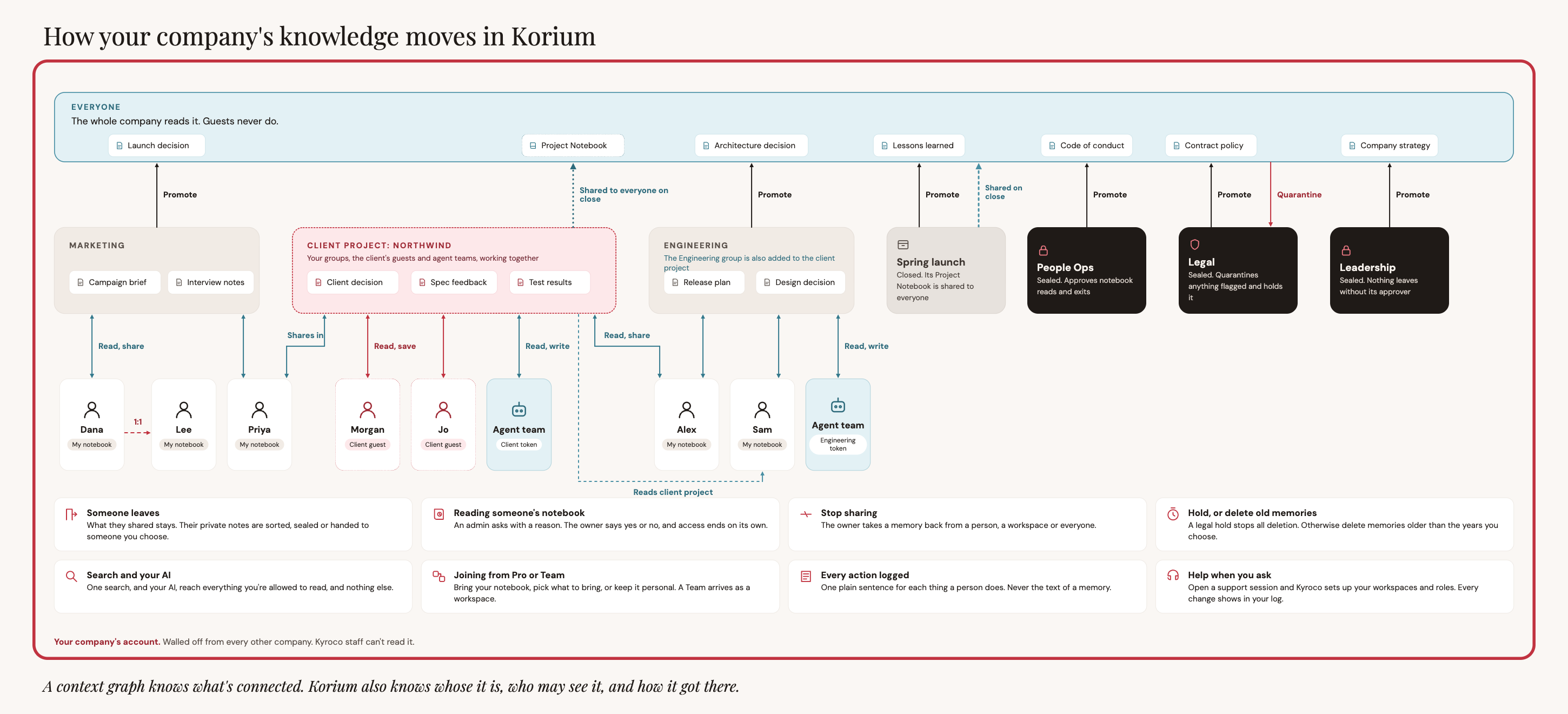
Korium is about to get more personal and more shared at the same time. People get their own notebook for what they know, and from there it can be shared with their team or the whole company, with clear rules about who decides. That means Jane can think things through on her own and share them when they're ready, Andy's team can find what he had already shared with them while he's away, and when Bob moves on for good, what he knew can stay with the company. Privacy is built in from the start, so a private note stays private everywhere someone might look for it, from search to the AI tool to the dashboard, and it goes beyond privacy to company structure, governance and sharing, with teams, clients, roles and approvals built in. It starts with the person, which is what this whole piece has been about, and there's more to say as it gets closer.
Citation List
Covering work during leave
- U.S. Department of Labor, Chief Evaluation Office. "Employee and Worksite Perspectives of the Family and Medical Leave Act: Results from the 2018 Surveys, Final Report." Abt Associates, July 2020. Worksite survey of 1,981 worksites on how leaves of a week or more get covered: 58% most often reassign the work to other employees, and 65% have asked employees to do some work while on leave. I read the executive summary and Section 7.2, not the whole report. Report
Time off after a death
- U.S. Department of Labor. "Funeral Leave." The Fair Labor Standards Act does not require pay for time not worked, including attending a funeral, and the benefit is generally a matter of agreement between employer and employee. DOL